For years, the reigning wisdom in business technology was “best-of-breed”: for every job, pick the single best tool for that specific job. Best hosting here, best form tool there, best project manager, best file sharing, best analytics. Assemble the champions of every category and you get the best possible system. It sounds obviously correct. It is also, for most small businesses and agencies, quietly wrong — and the reason it is wrong is a cost almost nobody puts on the invoice.
Best-of-breed optimizes each part in isolation while ignoring the thing that actually determines whether your technology works: how the parts fit together. You end up with a collection of individually excellent tools that were never designed to cooperate, and you personally become the integration layer holding them together with manual effort, brittle automations, and hope. The champions do not form a team. They form a pile — and running a pile has a price.
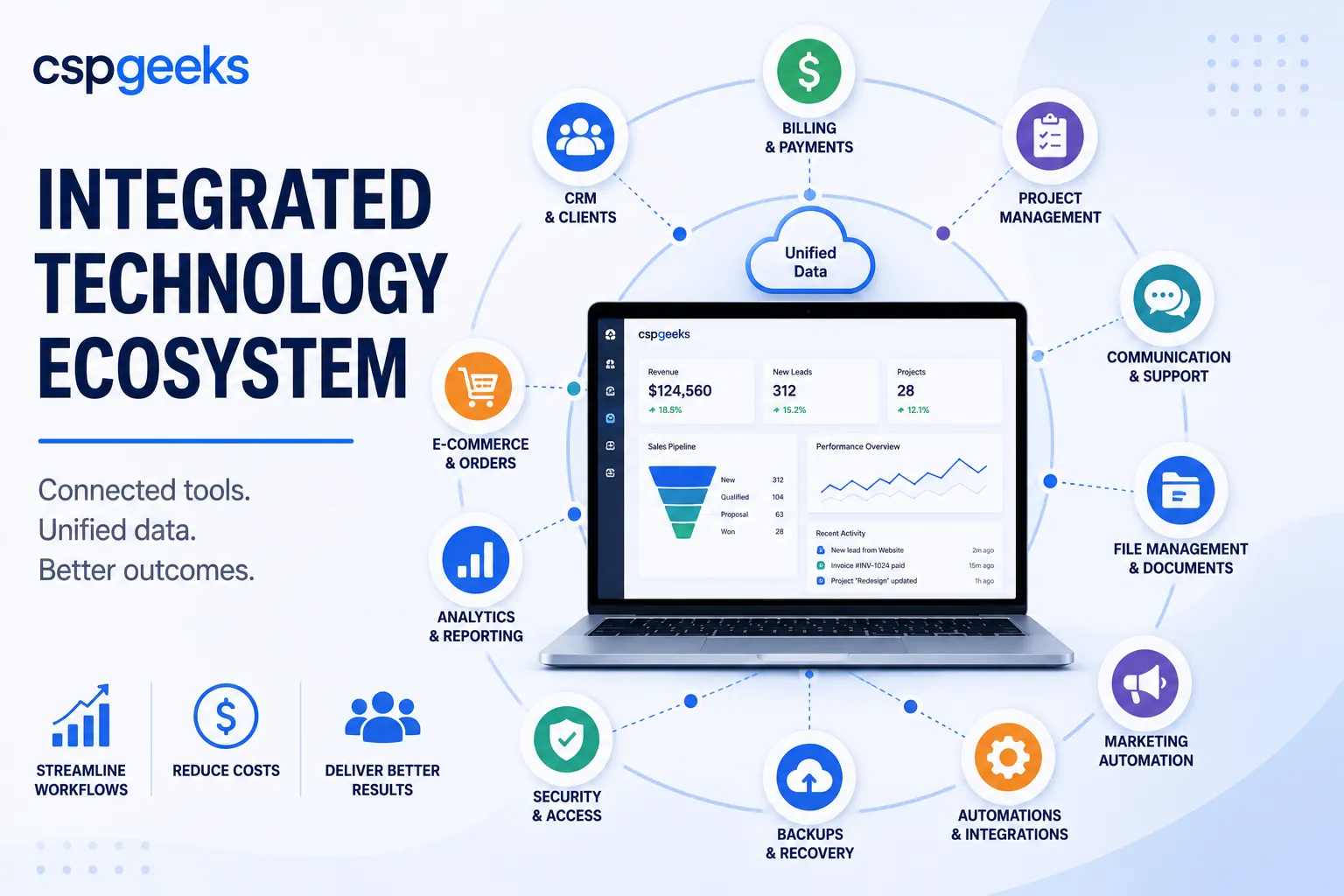
This is the capstone argument that ties together everything in this series. Each of the other articles examined one pressure — pricing, security, backups, SEO, analytics, collaboration, automation. This one is about the meta-pattern underneath all of them: that a coherent, integrated ecosystem beats a pile of best-of-breed tools, not because any single piece is superior, but because the whole is worth more than the sum of its parts. Let us make that case honestly, including where it does not hold.
The hidden integration tax
Start with the cost nobody quotes you. When your tools do not work together natively, someone has to make them cooperate, and that someone is you and your team. This is the integration tax, and it is paid continuously, in several currencies.
It is paid in time: the manual effort of moving data between systems, reconciling information that lives in multiple places, and doing by hand the handoffs that connected tools would do automatically. Every gap between two disconnected tools is a place where a human has to stand and pass the bucket.
It is paid in errors: every manual transfer is a chance to mistype, to miss a step, to work from a stale copy. Disconnected systems drift out of sync, and someone eventually acts on the wrong version of the truth.
It is paid in brittleness: the automations and integrations you build to bridge the gaps are fragile. A tool updates, an API changes, a connector silently breaks, and a workflow you depended on stops working — often without announcing it, so you discover the failure downstream, after it has caused a problem.
It is paid in overhead: more tools mean more bills, more vendors, more renewals, more logins, more support relationships to manage, more things to learn and keep learning. That is real work, and on a lean team it lands on the very people you need doing client work.
And it is paid in cognitive load: someone has to hold the whole fragmented picture in their head, remember how the pieces connect, and know which system holds which truth. That mental burden is invisible and exhausting, and it does not scale.
Here is the part that makes it insidious: the integration tax is mostly hidden. It does not appear as a line item. It is diffused across everyone’s time, buried in the errors you fix and the fires you put out, hidden in the hours that vanish into keeping the pile standing. Because you cannot see it clearly, you systematically underestimate it — and keep adding tools, each of which raises the tax a little more. Recall the scale: the typical organization now runs anywhere from 100 to more than 300 applications, up from fewer than 20 a decade ago, per industry research compiled by JumpCloud. Every one of those is another connection to maintain, another tax to pay. The pile does not just cost money. It costs the focus you needed for the actual work.
Unified identity: one front door, one key ring
The first thing a coherent ecosystem gives you that a pile cannot is unified identity — one place where people and their permissions live, spanning the whole system, instead of a separate account, login, and permission model in every tool.
The benefits are practical and immediate. Onboarding a new team member means granting appropriate access once, across the environment, rather than provisioning them separately in twenty systems and inevitably missing a couple. Offboarding — the one that actually bites — means removing their access once and being genuinely confident they are out, instead of hunting through two dozen tools hoping you did not leave a door open. In a pile, offboarding is a scavenger hunt, and every tool you forget is a former contractor with lingering access to something. That is not a hypothetical risk; it is one of the most common quiet security failures there is.
Unified identity also makes access legible. You can actually see who has access to what across your systems, because it lives in one place. In a pile, no one can straightforwardly answer “what can this person reach?” — the answer is scattered across every tool’s separate settings. Legibility is the precondition for control, and a pile is fundamentally hard to see clearly, let alone govern.
Security consistency: one standard, not twenty
We devoted whole articles in this series to security and backups because they matter enormously and are so easily neglected. The ecosystem argument for both is the same and worth stating plainly: consistency.
In a best-of-breed pile, your security posture is only as strong as the weakest tool in the collection, and you are trusting each separate vendor to independently patch, monitor, harden, and back up their corner of your world to a standard you cannot easily verify. Your data scatters across all of them, each with its own posture, its own login, its own place to be breached. Security becomes a function of the least careful vendor and the tool you forgot you were still using. Recall that shadow IT accounts for roughly a third of the applications in use at many organizations — a large share of your risk can live in tools leadership does not even know are running.
A coherent ecosystem applies one consistent standard across the foundation. Patching, monitoring, backups, access control, and encryption follow the same rules everywhere, so there are fewer weak links, fewer independent things to verify, and fewer forgotten corners. The same holds for backups and recovery: a unified approach means one dependable strategy rather than crossing your fingers that each of a dozen vendors independently protects and can restore your data. Consistency is not glamorous, but in security it is most of the battle, because attackers only need the one weak link and a pile is nothing but links.
Operational simplicity: the compounding dividend
Beyond identity and security, a coherent ecosystem pays an operational dividend that compounds quietly over time — and for a lean team, this is often the benefit that matters most day to day.
There are fewer things to manage: fewer bills, fewer vendors, fewer renewals, fewer support contacts, fewer logins, fewer interfaces to learn. That reclaimed attention goes back into the work you are actually in business to do. There is less to learn, so onboarding is faster and institutional knowledge concentrates in one environment instead of fragmenting across twenty. Growth becomes routine rather than an event: adding a client or a project is a known, repeatable motion rather than a fresh round of stitching tools together, because the pieces already connect. And data becomes usable together, so the cross-cutting questions that a pile leaves permanently unanswerable — how profitable is this client, which channel produces customers who stay — finally have answers, because the information is no longer trapped in silos that never meet.
None of these is dramatic on its own. Together, and compounding month over month, they are the difference between a business that spends its energy on clients and one that spends a surprising share of it feeding and maintaining its own tooling. Operational simplicity is not a luxury for the lean team. It is oxygen.
The honest counterargument: when best-of-breed wins
A trustworthy case admits where it breaks, so here is the honest counterweight, because the ecosystem argument is not absolute and treating it as a religion would be its own mistake.
Best-of-breed genuinely wins in specific situations. When you have a highly specialized need where a niche tool is dramatically better than any integrated option, that specialization can be worth the integration cost — some jobs really do call for the specialist. When a category is peripheral to your operation and does not need to share data with everything else, integration matters less and you can pick freely on the merits. And the real risk of the ecosystem approach — lock-in — is legitimate: consolidating onto one foundation means depending on it, and if that foundation raises prices, stagnates, or fails you, switching is painful precisely because it is integrated.
So the honest position is not “always choose an ecosystem.” It is choose an ecosystem for your foundation, and be pragmatic at the edges. Consolidate the core systems where integration, security, and shared data matter most — hosting, identity, client-facing workflows, the places data needs to flow. Stay flexible with peripheral, specialized tools that a coherent foundation does not need to absorb. And protect yourself against lock-in the right way: insist on data portability, clear export options, and reasonable terms before you commit, so that “integrated” never quietly becomes “trapped.” An ecosystem you can leave is one you can trust to stay.
The distinction from the old best-of-breed doctrine is this: that philosophy treated every decision as isolated and best optimized alone. The ecosystem view recognizes that foundation decisions are not isolated — they define how everything else fits — and should be made for coherence, while genuinely peripheral decisions can still be made on the merits. It is a both/and, not a purity test.
Future-proof growth: designed to be added to
The final advantage of a coherent ecosystem is that it is built to grow with you, whereas a pile becomes more fragile with every tool you add.
In a pile, growth makes things worse. Each new tool multiplies the connections to maintain, raises the integration tax, adds another security surface, and increases the cognitive load of holding the whole picture together. Complexity compounds against you, and the system that got you here actively resists getting you to the next stage. Scaling a pile means scaling its fragility.
A coherent ecosystem is designed to be extended. New capabilities are meant to fit the foundation and share its identity, security, and data, so adding them strengthens the system instead of straining it. Growth is a smooth progression up tiers of capacity rather than a disruptive re-platforming every time you double in size. That is what “future-proof” should actually mean — not that you will never change anything, but that growth builds on the foundation rather than fighting it. You want a system where getting bigger makes you stronger, not more brittle. That is the whole difference between an ecosystem and a pile.
An ecosystem checklist
- You can see the full integration tax — the manual handoffs, duplicate data entry, and brittle connectors your team maintains today.
- Your foundation is coherent — hosting, identity, and core client systems are integrated rather than stitched together.
- Identity is unified, so onboarding and, crucially, offboarding happen once across the environment.
- Security follows one consistent standard, not the posture of your weakest or most-forgotten tool.
- Backups and recovery are unified, not left to a dozen vendors independently.
- Data can be read across systems, so cross-cutting questions are answerable.
- The edges stay flexible — specialized, peripheral tools are chosen on the merits.
- You are protected against lock-in by data portability and reasonable terms.
- Growth builds on the foundation rather than multiplying fragility.
Frequently asked questions
Isn’t best-of-breed always better since you get the best tool for each job? Only if you ignore integration cost, which is exactly the mistake. Best-of-breed optimizes each part alone and leaves you to be the glue — paying the integration tax in time, errors, and fragility. For your foundation, a coherent ecosystem usually wins because the whole works better together. For peripheral, specialized needs, best-of-breed can still be the right call.
Doesn’t an integrated ecosystem just mean vendor lock-in? It is a real and legitimate risk, and the answer is not to avoid ecosystems but to enter them wisely: insist on data portability, clear export options, and reasonable terms before committing, and keep peripheral tools swappable. An ecosystem you can leave is one you can trust. Lock-in is a contract-and-portability problem, not an inherent property of integration.
We’re a small team. Is an ecosystem overkill for us? Usually the reverse. Lean teams feel the integration tax more acutely than large ones, because there is no dedicated IT function to absorb it — it lands on the people doing client work. Operational simplicity and unified identity are arguably more valuable at small scale, not less.
How do I move toward an ecosystem without a disruptive rip-and-replace? Incrementally. Choose your foundation first, then migrate one workflow at a time, running new alongside old until you trust it, and consolidate access as you go. It is the same measured, reversible approach that keeps any migration from becoming a catastrophe — slow and safe beats fast and fragile.
Where CSP Geeks fits
Everything in this series has been building to a single idea, and it is the idea the CSP Geeks ecosystem was created around: technology should remove complexity, not create it. We watched agency after agency forced to stitch together disconnected tools — hosting from one company, forms from another, portals somewhere else, project management somewhere else — and pay for it in time, money, and focus. So we built an alternative.
At the center is Press Mage, a private-cloud platform built specifically for agencies that provisions and manages the foundation. Around it sit the pieces that share that foundation, each addressing a pressure from this series: GVenta, SaaS applications for lean teams without the per-seat tax; Mage Intake, secure forms and intake APIs that developers actually enjoy using; Mage Shares, a simpler and safer way to collaborate with clients and share files; and the CSP Geeks Travel Division, bringing decades of travel-technology experience to agencies, tour operators, and travel businesses. Different products, one philosophy — coherence over chaos, so you spend less time fighting your tools and more time growing your business and serving your clients.
You do not have to adopt all of it, and you do not have to do it overnight — a coherent foundation is something you grow into deliberately. If you want to understand what the pile is really costing you and what a coherent foundation would change, start with a free ecosystem assessment. We will map your current stack, surface the hidden integration tax, and give you an honest roadmap — the same measured, no-pressure approach we would want if the roles were reversed.
Related reading: Why Per-Seat Pricing Is Costing Your Agency More Than You Think · The Agency Technology Stack That Actually Scales · Your Website Is Not Secure Just Because It Has HTTPS · Stop Emailing Sensitive Files