
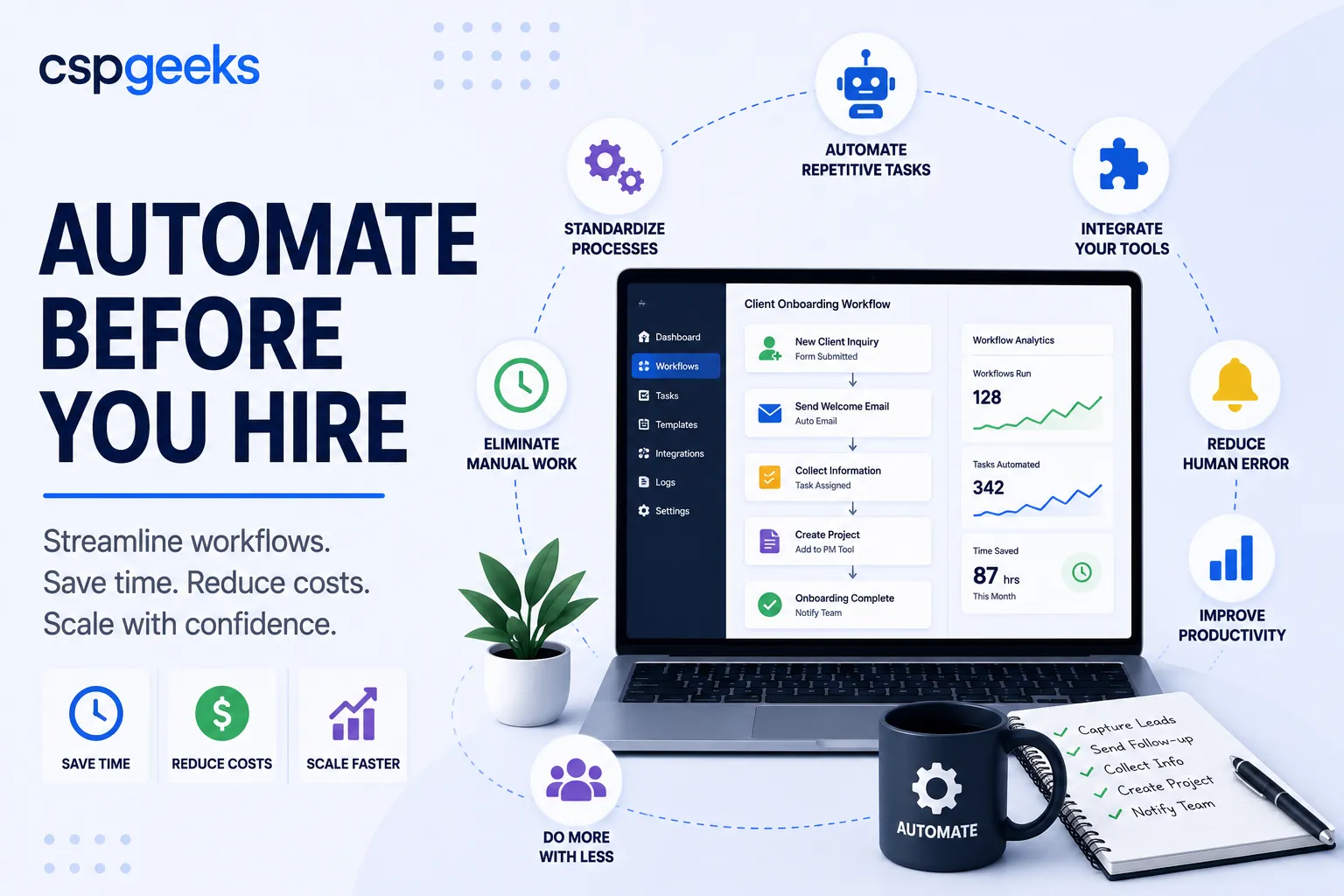
When a small business or agency starts feeling stretched, the instinct is almost universal: we need to hire someone. The team is drowning, work is slipping, so the answer must be more hands. Sometimes that is exactly right. But surprisingly often, the business is not short on people. It is short on process — and it is about to spend a great deal of money hiring a human to perform work that should not be done by a human at all.
Here is the uncomfortable truth worth sitting with before you post that job listing: a meaningful share of what keeps your team busy is repetitive, rule-based, and predictable — copying data between systems, sending the same follow-ups, chasing the same information, moving files, updating the same records. This is precisely the work that automation handles well and that people handle poorly, expensively, and resentfully. Hire a person into that work and you have bought yourself an expensive, hard-to-scale way to do something a well-built workflow could do for a fraction of the cost, instantly, and without burning out.
This article makes the case for automating before you hire: how to spot the work worth automating, where AI genuinely fits versus where it is hype, why structured intake is the foundation of all of it, why human oversight still matters, and how to actually get started without boiling the ocean.
The case for automating first
The logic is simple once you separate two kinds of work. Some work genuinely requires human judgment, creativity, relationships, and expertise — the work you presumably started your business to do. Other work is mechanical: predictable, rule-based, repetitive, and, frankly, beneath the people doing it. Every hour your skilled team spends on mechanical work is an hour not spent on the valuable work, and it is an hour you are paying a premium for.
Hiring to cover mechanical work is expensive in ways that go well beyond salary. There is recruiting, onboarding, management, benefits, and the simple fact that a human doing repetitive work gets bored, makes mistakes, and eventually leaves — taking the undocumented process with them. Automation, by contrast, does not get bored, does not make the same slip on the four hundredth repetition that it made on the first, does not need managing once it works, and scales instantly. When your volume doubles, an automated workflow just runs twice as often. A human has to be hired, trained, and absorbed.
None of this is an argument against hiring people. It is an argument about sequence and fit. Automate the mechanical work first. Then, when you do hire, you hire into genuinely valuable work — and your new person spends their time on things worthy of a human instead of inheriting a pile of copy-paste drudgery. You get more from every hire because you stopped using expensive humans as glue between your systems. Automate first, and hire better.
Finding your automation candidates
Not everything should be automated, and chasing the wrong targets wastes effort. The best candidates share a recognizable profile: the task is repetitive (it happens often), rule-based (the steps are consistent and decidable without much judgment), structured (it works with predictable information), time-consuming in aggregate (the minutes add up), and error-prone when done by hand (people slip on tedious work). The more of these a task hits, the stronger the candidate.
In most small businesses and agencies, the same suspects come up again and again:
- Data entry and transfer — copying information from one system to another, re-keying the same details in multiple places. This is the purest automation candidate there is, and one of the most common time sinks.
- Client and lead intake — collecting information, routing it to the right person, kicking off the next step. Almost always done more slowly and less reliably by hand than it needs to be.
- Notifications and follow-ups — the reminders, confirmations, status updates, and nudges that eat time and get forgotten exactly when they matter.
- Routing and assignment — getting the right work or request to the right person based on consistent rules.
- Reporting — pulling the same numbers into the same format on the same schedule, by hand, every single time.
- Onboarding sequences — the repeatable steps that fire every time you land a new client or start a new project.
A useful way to find your own candidates: for one week, have the team jot down the repetitive, mechanical tasks they do and roughly how long each takes. The list is usually eye-opening — hours a week, across the team, poured into work no human should be doing. That list is your automation roadmap, sorted by how much time each item drains.
AI versus automation: telling the two apart
“Automation” and “AI” get blended into one buzzword, which muddies decisions. They are different tools for different jobs, and knowing which is which keeps you from using an unpredictable tool where you needed a reliable one.
Traditional automation follows explicit rules you define. When this happens, do that. It is deterministic, predictable, and reliable — the same input produces the same output every time. This is what you want for the bulk of business processes: moving data, routing requests, sending notifications, enforcing a sequence of steps. You want these things boringly consistent, and rule-based automation is exactly that.
AI handles tasks that resist hard rules — understanding messy language, summarizing, classifying ambiguous inputs, drafting content, extracting meaning from unstructured information. It is powerful and increasingly practical, but it is probabilistic rather than deterministic: it can be wrong, it can be confidently wrong, and it needs oversight. That is a feature where you need flexibility and a liability where you need certainty.
The practical guidance is unglamorous and correct: use rule-based automation for anything that can be expressed as rules, and reserve AI for the genuinely fuzzy parts. Reaching for AI on a task that plain automation would handle deterministically adds cost, unpredictability, and a supervision burden you did not need. The best real-world systems tend to combine them — rules for the reliable backbone, AI at the specific points where judgment or language understanding is required — with the AI’s output checked before it drives anything consequential. Match the tool to the task and you get reliability where you need it and flexibility where you want it.
Forms and workflows: structured intake is the foundation
Here is a piece that is easy to overlook: most automation lives or dies on the quality of the information going into it, and that means the humble form and the structured workflow are the real foundation of everything above.
Automation needs structured, predictable input. When information arrives as free-form email or a phone call — “hey, can you also do this thing for that client” — a human has to interpret it, extract the details, and enter them somewhere before anything can be automated. That interpretation step is manual, slow, and exactly the kind of work you were trying to eliminate. Garbage or unstructured input at the front means a human bottleneck no matter how clever the downstream automation is.
Structured intake fixes this at the source. A well-designed form collects the right information, in the right format, validated at the point of entry, so it arrives clean and machine-ready. From there it can flow automatically: route to the right person, create the right record, trigger the next step, send the confirmation — no human required to transcribe or interpret. The form is not a trivial detail. It is the on-ramp that makes the whole automated highway possible, which is why serious intake tooling — secure, validated, API-friendly forms — is worth taking as seriously as the workflows it feeds.
Then think in workflows, not isolated tasks. A workflow is the whole sequence — intake to routing to action to notification to record-keeping — designed to flow with as little manual intervention as possible. Automating one step while the steps around it stay manual yields limited gains and often just relocates the bottleneck. Mapping and automating the whole sequence is where the real time savings live.
Human oversight: automate the work, not the judgment
An honest article on automation has to be clear about its limits, because over-automating is a real and costly failure mode. The goal is to automate the mechanical work while keeping humans firmly in charge of judgment, exceptions, and relationships. Automation should amplify your team, not replace their thinking.
Human oversight matters in several specific places. It matters at decision points that carry real weight — anything with significant financial, legal, or relationship consequences deserves a human in the loop rather than a rule firing unseen. It matters for exceptions, because automation handles the standard case well and the unusual case badly; a good system routes the weird cases to a person instead of forcing them down a path that does not fit. It matters for anything client-facing and sensitive, where efficiency should never cost you the human warmth of the relationship — automating away the feeling that a real person is paying attention is a false economy. And it matters as ongoing supervision, because automation can fail silently, and someone should be watching that it is still doing the right thing rather than confidently doing the wrong thing at scale.
This is doubly true for AI, whose probabilistic nature makes unsupervised operation on consequential tasks genuinely risky. The right posture is a partnership: let automation carry the repetitive load reliably, and keep people where judgment, exceptions, and relationships live. Automate the work. Keep the judgment.
An implementation plan that won’t overwhelm you
The way automation efforts fail is by trying to do everything at once — a giant project that stalls, overwhelms, and gets abandoned. The way they succeed is incremental: one workflow at a time, starting small, building confidence and momentum.
A sane sequence:
- Identify and prioritize. Run the one-week tracking exercise, list your repetitive tasks with their time cost, and rank by impact and simplicity. Look for the high-drain, low-complexity wins to start.
- Start with one high-value, low-risk workflow. Not your most critical or complex process. Pick something that is clearly painful but contained, so a stumble is survivable and a win is obvious. Prove the value and build belief.
- Map it fully before automating. Understand the whole current workflow, end to end, including the exceptions, before you build. You cannot reliably automate a process you have not clearly described.
- Build, structuring the intake first. Get clean input at the front with a good form, then automate the flow through to the end. Keep humans at the decision and exception points on purpose.
- Test, refine, and watch it. Run it, confirm it behaves — especially on the odd cases — and add monitoring so silent failure gets noticed.
- Then move to the next. With one win banked and a template in hand, tackle the next workflow. Momentum compounds, and each one gets easier.
Incremental beats heroic every time. A series of small, contained automations that each free up real hours will get you far further than one grand initiative that collapses under its own weight.
An automation checklist
- You have listed your repetitive, mechanical tasks and roughly what each costs in time.
- Candidates are prioritized by impact and simplicity, not by whatever is loudest.
- You use rule-based automation for rule-based work, and reserve AI for genuinely fuzzy tasks.
- Intake is structured — clean, validated forms feed the workflows rather than free-form email.
- You automate whole workflows, not isolated steps that just move the bottleneck.
- Humans stay in charge of consequential decisions, exceptions, and client relationships.
- AI outputs are supervised before they drive anything that matters.
- You started small with one contained win and are expanding from there.
Frequently asked questions
Should I really automate before hiring, even when the team is clearly overloaded? Look first at what is causing the overload. If a large share of it is repetitive, mechanical work, automating that may relieve the pressure faster and far more cheaply than hiring — and it means any hire you do make goes toward valuable work rather than drudgery. If the overload is genuinely skilled work, then hire. It is about sequence and fit, not never hiring.
Is AI going to replace the need for regular automation? No — they solve different problems. Rule-based automation is deterministic and reliable, which is exactly what you want for most business processes. AI shines on fuzzy, language-heavy, judgment-adjacent tasks but is probabilistic and needs oversight. The strongest systems combine them: rules for the backbone, AI for the genuinely ambiguous parts.
What should I automate first? Something high-value but low-risk and contained — a clearly painful, repetitive workflow where a stumble is survivable. Data entry, intake and routing, and follow-ups are common first wins. Prove the value on something manageable, then expand with the confidence and template you have built.
Isn’t there a risk of automating away the personal touch clients value? Yes, and it is a real failure mode. The rule is to automate the mechanical work and keep humans in charge of relationships, judgment, and exceptions. Used well, automation frees your team to spend more time on the human parts by taking the drudgery off their plate — not less.
Where CSP Geeks fits
Automation runs on clean input and connected systems, which is precisely where the CSP Geeks ecosystem is built to help.
Mage Intake provides the structured, secure, developer-friendly forms and intake APIs that give your workflows clean, validated information at the front — the on-ramp that makes everything downstream automatable instead of manual. GVenta brings SaaS applications for lean teams that help you run structured workflows without a per-seat tax on everyone involved. And because these sit on the shared Press Mage foundation, the handoffs between intake, workflow, and the rest of your stack are designed to connect rather than requiring you to be the glue between disconnected tools.
If you suspect your team is spending real hours on work a good workflow could handle, that suspicion is usually correct and usually worth acting on before your next hire. We are happy to help you find your best automation candidates and build the first workflow — start with an automation assessment, and we will show you where the hours are going and what it would take to get them back.
Related reading: If You Can’t Measure It, You Can’t Improve It · The Agency Technology Stack That Actually Scales · Why Per-Seat Pricing Is Costing Your Agency More Than You Think